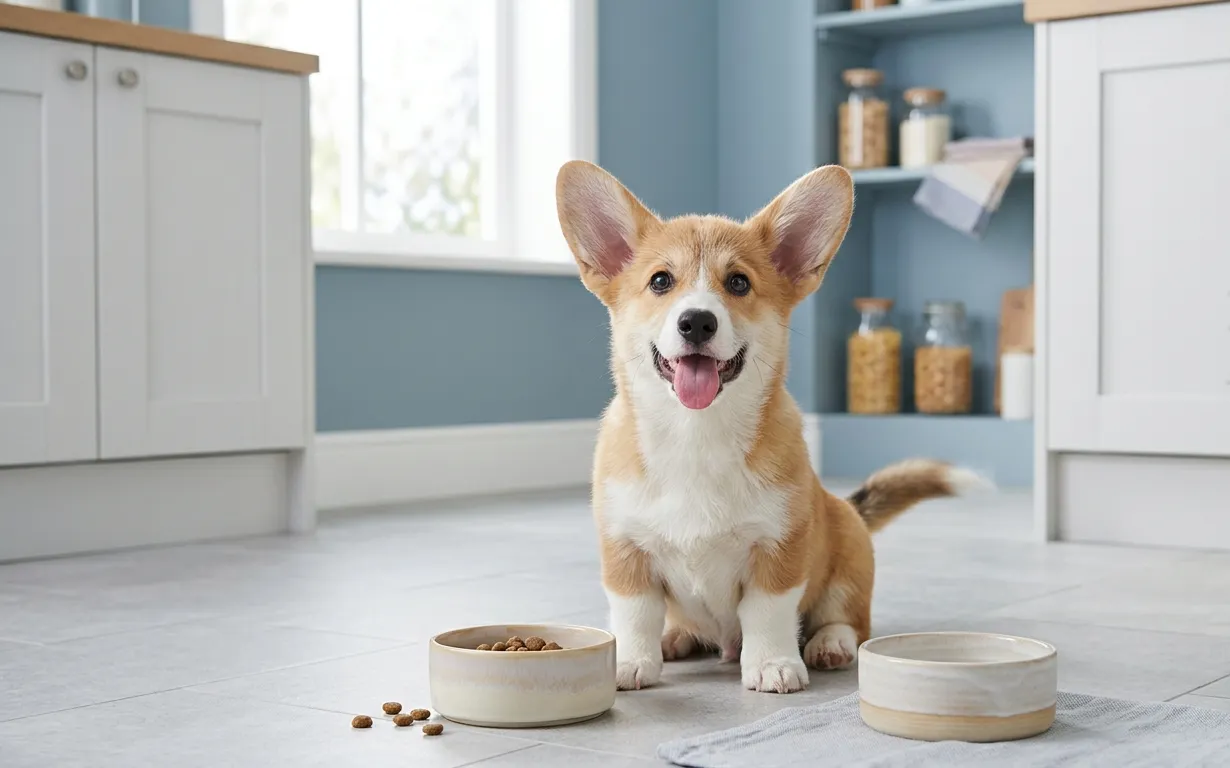
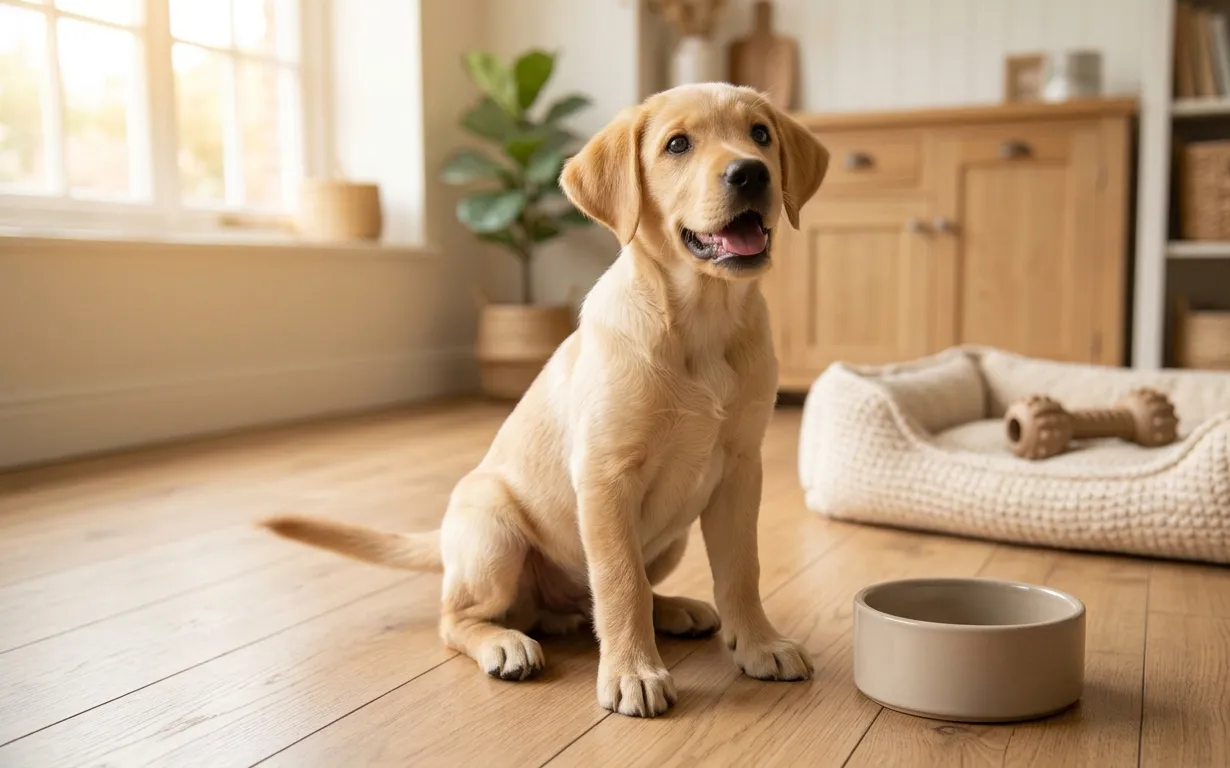
At 6 months, most puppies weigh about two-thirds of their adult weight: around 70% for small breeds and 63–65% for the biggest. To estimate adult weight, multiply the 6-month weight by about 1.4 for small dogs and 1.5–1.6 for large and giant dogs.
That's a lot less than the "double it" or "triple it" rules you'll find online. Those numbers come from growth records of more than 100,000 healthy puppies (see about the data). Here's how to use them, and which popular rules hold up.
How big will my puppy get? The 6-month rule by size
| Size (adult weight) | Share of adult weight at 6 months | Multiply 6-month weight by |
|---|---|---|
| Toyunder 14 lbs | 71% | 1.41.1–1.8 |
| Small14–20 lbs | 72% | 1.41.1–1.8 |
| Medium20–33 lbs | 69% | 1.451.2–1.8 |
| Large33–66 lbs | 68% | 1.51.25–1.75 |
| X‑Large66–88 lbs | 65% | 1.551.3–1.85 |
| Giant88+ lbs | 63% | 1.61.35–1.85 |
The small numbers under each multiplier show the range for the middle half of puppies. Even at the top of that range, no size comes close to doubling after 6 months.
Example: a Labrador puppy who weighs 45 lbs at 6 months will most likely end up around 70 lbs (45 × 1.55), and probably somewhere between 59 and 83 lbs. The "triple it" rule would predict 135 lbs, the size of a Great Dane.
Which puppy size rules actually work?
| Rule you'll see online | What the data says |
|---|---|
| Double the 6-month weight | Too high for every size. The real multiplier is 1.4–1.6. |
| Triple the 6-month weight for large breeds | Far too high. Large and giant dogs multiply by about 1.5–1.6. |
| Double the 16-week (4-month) weight | Works for toy and small breeds (about ×2.0). Too low for bigger dogs: about ×2.25 for medium, ×2.5 for large and ×2.8 for giant. |
| Look at the paws | A loose clue at best (see below). |
Why does the 16-week rule work for small dogs but not big ones? Small puppies are already further along at 16 weeks, about half their adult weight. A giant puppy at 16 weeks is only about a third of the way there, so it has much more growing left.
Is a dog fully grown at 6 months?
No. At 6 months, a puppy still has about 28–37% of their adult weight left to gain, depending on size. Growth slows down from here, though. Most puppies reach about 85–89% of their adult weight by 9 months and about 90% by 10 months.
So a 6-month-old puppy may look almost adult-sized, especially a small breed, but will keep filling out for several more months. Large and giant dogs keep adding a little into their second year. Around this age, most puppies also move from three meals a day to two (see how many times a day to feed a puppy). For the full timeline, see when do puppies stop growing.
At what age do puppies double their weight?
Counting from 8 weeks, when most puppies go home:
- Large and giant puppies double their 8-week weight by about 14–15 weeks.
- Medium puppies by about 16 weeks.
- Small and toy puppies by about 18–21 weeks.
Bigger puppies double sooner because they're in their fastest growth phase at that age. Read more in puppy growth spurts.
Do puppy paws show how big a dog will get?
Only roughly. A puppy with big paws is often a bigger breed, but paw size varies by breed in ways that have nothing to do with adult weight. Basset Hounds, for example, have large paws without being large dogs. We couldn't find any study that measured puppy paws against adult size, so treat this one as folklore.
Better clues, from most to least reliable:
- Weight and age together, using the multipliers above.
- The parents' size, if you know it.
- Breed, or a DNA test for mixed breeds.
What about mixed-breed puppies?
The multipliers work for mixed breeds too, because they depend on how big the dog will be, not on breed. If you don't know which size group your puppy falls into, start with the medium multiplier (×1.45), then check which size your result lands in and adjust. Our calculator does this automatically.
Get an estimate for your puppy
Enter your puppy's age and current weight in our puppy weight calculator. It uses the same growth data to estimate adult weight and a likely range, at any age from 8 weeks to a year. To compare your puppy with typical weights for their size, see the puppy weight chart.
About the data
Figures come from the public dataset of Salt et al. (2017), covering purebred dogs seen at Banfield Pet Hospitals in the US between 1994 and 2013. We kept visits where the vet recorded a normal body condition, grouped dogs by their breed's adult weight, and fitted a smooth growth curve to each group. "6 months" means 26 weeks. Multiplier ranges reflect the spread between the 25th and 75th percentile of individual puppies. The original study didn't publish curves for dogs over 40 kg (88 lbs), so treat Giant figures with some caution.
Sources
- Salt, C., Morris, P. J., German, A. J., et al. (2017). Growth standard charts for monitoring bodyweight in dogs of different sizes. PLOS ONE, 12(9), e0182064. doi.org/10.1371/journal.pone.0182064. Dataset: University of Liverpool (CC BY 4.0).
This article is for informational purposes only and is not a substitute for professional veterinary advice. Always consult a licensed veterinarian for questions about your dog's health.