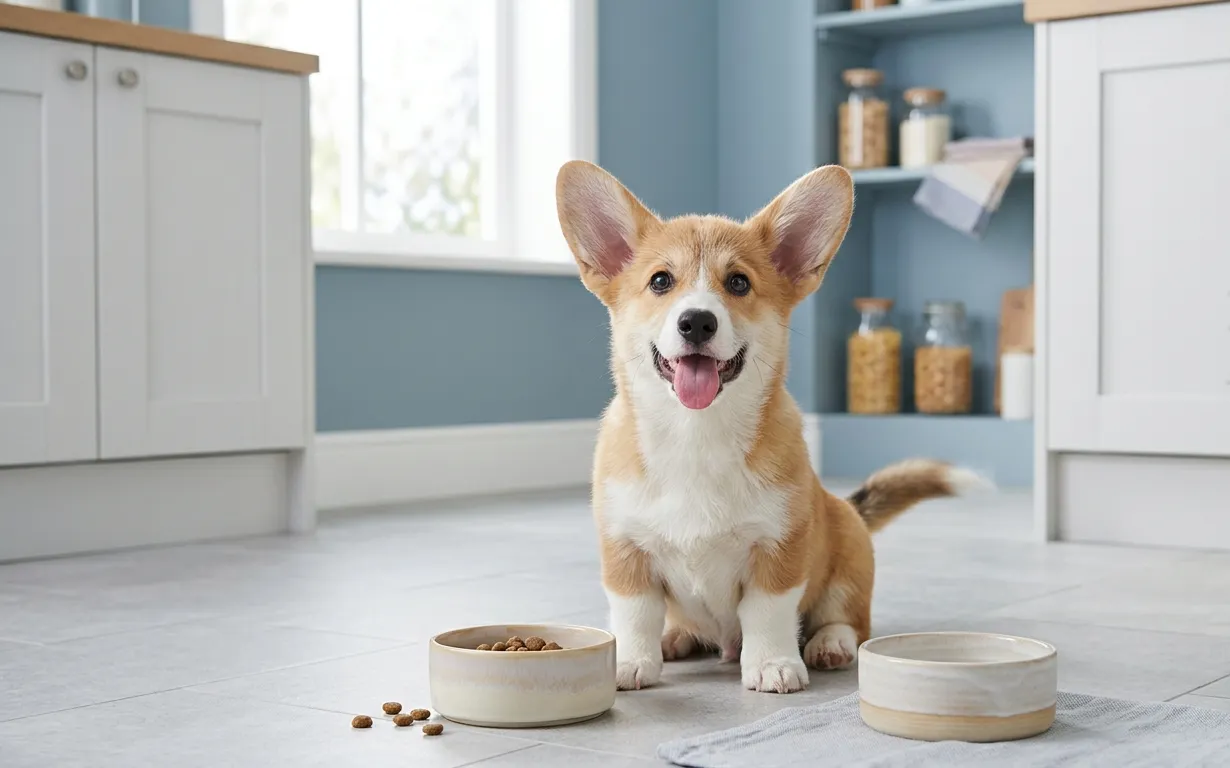
Puppies grow fastest from the time you bring them home, at about 8 weeks, until 5–6 months. The single biggest stretch comes at 10–16 weeks, depending on size. That's when most owners say their puppy "shot up overnight."
In growth records from more than 100,000 healthy puppies (see about the data), this looks less like a series of short spurts and more like one long growth phase that rises, peaks and slows down. Here's what that means for timing, signs and feeding.
When do puppies have growth spurts?
| Size | Biggest growth (week) | Fast phase | Peak gain (lbs/week) |
|---|---|---|---|
| Toyunder 14 lbs | ~10 | 8 wk – 5 mo | 0.2 |
| Small14–20 lbs | ~11 | 8 wk – 5 mo | 0.45 |
| Medium20–33 lbs | ~13 | 8 wk – 5.5 mo | 0.55 |
| Large33–66 lbs | ~15 | 8 wk – 5.5 mo | 1.8 |
| X‑Large66–88 lbs | ~16 | 8 wk – 6 mo | 2.1 |
| Giant88+ lbs | ~16 | 9 wk – 6 mo | 2.7 |
"Biggest growth" is the age when a typical puppy gains the most weight per week. "Fast phase" is the period when weekly gain stays above 80% of that peak. Bigger puppies peak a few weeks later and stay in the fast phase a little longer.
How long does a puppy growth spurt last?
The fast phase lasts about 3–4 months, not a few days. A Labrador puppy gains around 2 lbs a week for most of that time, which adds up to roughly 30 lbs between 8 weeks and 6 months.
It can still feel sudden. You don't notice a puppy getting slightly bigger every day. You notice the day the harness won't close or they can suddenly reach the couch. Vet records weigh puppies weeks apart, so they can't show whether growth comes in bursts of a few days. What they do show clearly is the overall shape: fast, then faster, then steadily slower.
How many growth spurts do puppies have?
In terms of weight, there's one main phase, in the first six months. After that:
- 6–12 months: growth slows down steadily. By 9 months, most puppies are gaining only about a third of what they gained at their peak.
- After 12 months: large and giant dogs add another 5–10% of their weight in year two. That's mostly chest and muscle filling out, spread over a whole year. It's not a spurt.
Many owners also notice a "lanky" stage at around 5–8 months, when legs look too long for the body. That's a change in proportions, not a second growth spurt, and it evens out as the chest catches up.
Signs your puppy is in a growth phase
- Bigger appetite. Growing takes a lot of energy (see the next section).
- More sleep. Young puppies sleep most of the day. Extra naps after busy days are normal, as long as they're alert and playful when awake.
- Clumsiness. Their bodies are changing quickly, so coordination can lag behind for a while.
- Chewing. Adult teeth come in from about 3.5 to 7 months, right in the middle of the fast phase (VCA Animal Hospitals). Sore gums can make a puppy chew more and sometimes eat less for a day or two.
Why your puppy seems hungry all the time
Puppies need far more energy per pound than adult dogs. Using the standard NRC formula that many puppy feeding guides are based on, a Labrador puppy expected to reach about 66 lbs would need:
| Age | Weight | Calories per day | Per lb of body weight |
|---|---|---|---|
| 10 weeks | 14 lbs | ~1,200 | ~87 |
| 16 weeks | 25 lbs | ~1,600 | ~63 |
| 6 months | 43 lbs | ~1,800 | ~42 |
| 12 months | 63 lbs | ~1,750 | ~28 |
Two things stand out. Per pound, a 10-week-old puppy needs about three times as much as a 1-year-old. And the total amount of food keeps rising until about 6–7 months, even though weekly weight gain is already slowing by then. So the hungriest months often come just after the fastest growth.
These are estimates, not targets. Studies have found the formula can overestimate needs for some breeds, especially small ones in their first few months (Alexander et al., 2017). Start with the amount on your food's label, then adjust based on body condition. Our puppy feeding calculator works out these numbers for your own puppy, including how much they'll need over the next few months.
Growth spurt or something else?
Growth explains hunger, naps and clumsiness. It doesn't explain these, so call your vet if you see:
- Diarrhea or vomiting. Growth doesn't upset the stomach. A food change, eating something odd, parasites or infection can.
- Not eating for more than a day, or skipping meals along with low energy.
- Sleeping a lot and listless when awake. Tired after play is normal. Flat and uninterested is not.
- Limping. It isn't a normal part of growing. Young large-breed dogs can develop painful bone and joint conditions that need a vet's diagnosis.
What about growth spurts at 8, 9 or 10 months, or after 1 year?
By 8–10 months, most puppies have reached 80–90% of their adult weight, and weekly gain is small: about 0.3 lbs a week for a Labrador at one year. If your puppy suddenly looks bigger at this age, it's usually the chest filling out or the adult coat coming in.
After the first birthday, large and giant breeds grow only slowly. If your dog is gaining weight quickly after one year, it's more likely to be extra fat than growth. For the full timeline by size, see when do puppies stop growing.
How to support healthy growth
- Feed for the expected adult size. Large and giant breeds do best on a large-breed puppy food, which keeps calories and calcium in check.
- Measure meals. Free feeding makes it easy for big puppies to grow too fast, which strains developing joints. See how many times a day to feed a puppy for a schedule by age.
- Weigh weekly until 6 months, and compare to a puppy weight chart for their size.
- Check body condition with the WSAVA body condition chart. You should feel ribs easily without seeing them.
Check where your puppy is now
Enter your puppy's age and weight in our puppy weight calculator to see how much of their adult weight they've reached and how much growing is left. For a quick rule of thumb, see puppy weight at 6 months.
About the data
Growth timing comes from the public dataset of Salt et al. (2017), covering purebred dogs seen at Banfield Pet Hospitals in the US between 1994 and 2013. We kept visits where the vet recorded a normal body condition, grouped dogs by their breed's adult weight, and fitted a smooth growth curve to each group. Weekly gains are read from those curves. The original study didn't publish curves for dogs over 40 kg (88 lbs), so treat Giant figures with some caution. Calorie estimates use the NRC (2006) growth equation for a puppy with an expected adult weight of 30 kg (66 lbs), applied to the X-Large growth curve.
Sources
- Salt, C., Morris, P. J., German, A. J., et al. (2017). Growth standard charts for monitoring bodyweight in dogs of different sizes. PLOS ONE, 12(9), e0182064. doi.org/10.1371/journal.pone.0182064. Dataset: University of Liverpool (CC BY 4.0).
- National Research Council (2006). Nutrient Requirements of Dogs and Cats. National Academies Press. doi.org/10.17226/10668
- Alexander, J. E., Colyer, A., & Morris, P. J. (2017). Energy requirements for growth in the Yorkshire terrier. Journal of Nutritional Science, 6, e26. doi.org/10.1017/jns.2017.26
- VCA Animal Hospitals. Retained deciduous teeth (baby teeth) in dogs.
This article is for informational purposes only and is not a substitute for professional veterinary advice. Always consult a licensed veterinarian for questions about your dog's health.