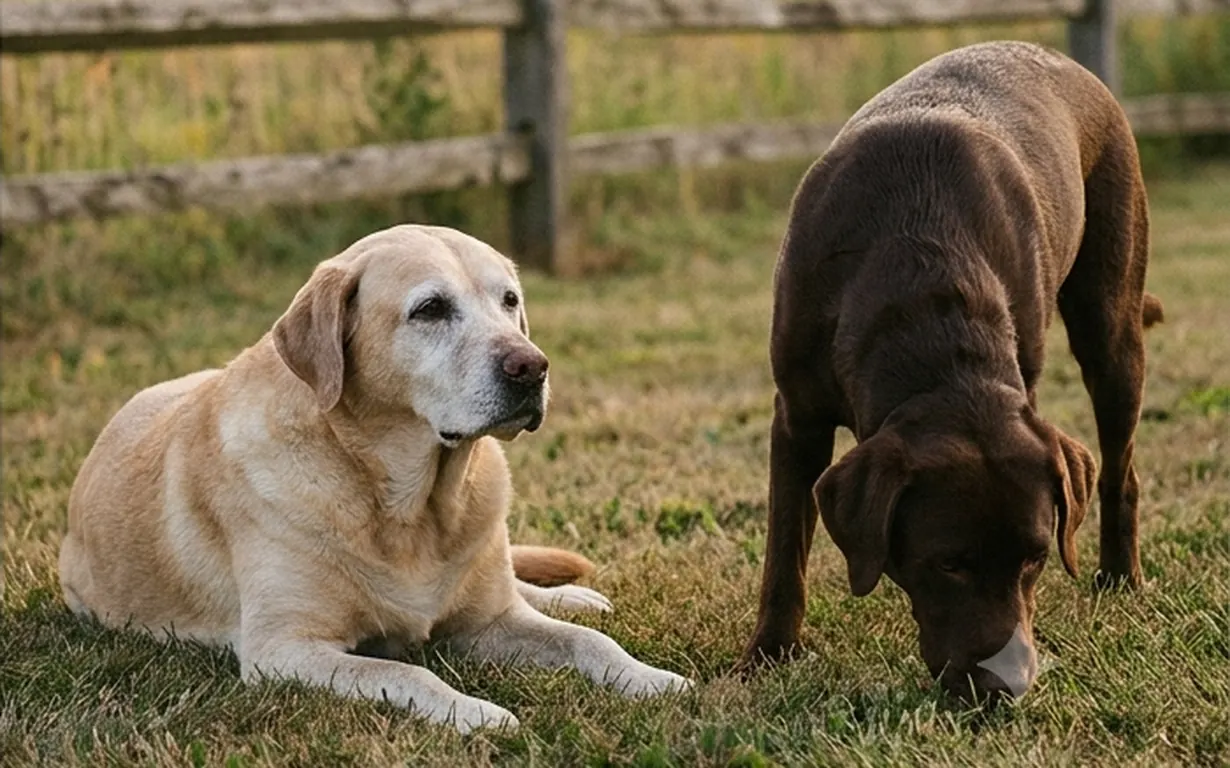
Labrador Lifespan: Why Chocolate Labs Lived Shorter Lives

Labrador Retrievers live a median of 13.1 years: half live longer, half don't get that far. That's from a 2024 study of UK dogs, which included 43,428 Labs, and it beats the 12.5-year median for dogs overall. One finding stands out from a smaller study: chocolate Labs died more than a year earlier than black and yellow ones.
Key takeaways
- The median Labrador lifespan is 13.1 years (McMillan et al. 2024), long for a dog this size.
- In a UK vet records study, chocolate Labs died at a median of 10.7 years, against 12.1 for other colors. Only 34 chocolate dogs were included.
- Males and females showed no real difference: 12.0 and 12.1 years.
- Joint and muscle problems were the most common recorded cause of death, followed by cancer.
- A Lab reaches the senior stage at just under 10.
How long do Labs live?
| Source | What it measured | Labrador |
|---|---|---|
| McMillan et al. 2024584,734 UK dogs, 43,428 Labs | Median lifespan | 13.1 years95% CI 13.0–13.1 |
| McGreevy et al. 2018176 UK Lab deaths | Median age at death | 12.0 years |
| Teng et al. 2022About 2,500 UK Labs | Life expectancy at birth | 11.77 years95% CI 11.67–11.89 |
| American Kennel Club | General breed range | 11–13 years |
The figures measure different things, so they don't need to match. A median tells you the age half of dogs reach. A life table estimate is pulled down more by deaths at young ages, and dogs overall scored just 11.23 on it, so Labs are above average on all three.
Do chocolate Labs really die younger?
In this 2018 UK study, yes, and the gap was statistically significant. Chocolate Labs also had more ear and skin disease than black or yellow Labs. The study doesn't prove that color itself shortens a dog's life, and it groups black and yellow together, so it can't say whether those two differ.
Keep the size of the sample in mind too: 34 chocolate deaths and 139 others. If you have a chocolate Lab, the useful takeaway isn't a shorter countdown. It's to stay on top of ear and skin problems and mention them to your vet early.
What do Labs usually die from?
Of 147 deaths with a recorded cause in the same study, these came up most often:
- Musculoskeletal disorders, 24.5%: joints, bones and muscles. These dogs died at a median of 13.4 years, the oldest of any common cause.
- Cancer, 21.1%: a median of 10.6 years.
- Mass lesions, 7.5%: lumps recorded without a confirmed diagnosis, at a median of 9.7 years.
Heart disease was far rarer, at 3.4%, but had the youngest median age of the top ten causes: 9.1 years.
Weight and joints are the everyday issues
The most common problems in a sample of 2,074 Labs were ear inflammation (10.4%), overweight or obesity (8.8%) and degenerative joint disease (5.5%). The last two can feed each other. Adult males averaged 35.2 kg (about 78 lbs) and females 30.4 kg (about 67 lbs), though a healthy weight depends on your dog's frame, so ask your vet to check body condition. If you're raising a Lab puppy, our puppy weight chart shows typical growth.
Do female Labs live longer than males?
Not in this study. Females died at a median of 12.1 years and males at 12.0, and that difference wasn't significant. Neutered Labs lived longer than intact ones, 12.5 years against 11.6, but a study of records like this can't show that neutering was the reason, since owners who choose it may differ in other ways too.
When is a Lab a senior?
At about 9 years and 10 months, the last 25% of a 13.1-year median lifespan. That's almost a year later than the 8.9 we use for large dogs in general, as explained in how old is my dog in human years. Your vet may start senior checkups earlier if your dog's joints or weight call for it.
How old is your Lab in human years? Enter their age for a breed-specific answer and life stage.
Labs and Golden Retrievers have almost the same median lifespan, but the Golden's story is quite different.
Frequently asked questions
How long do Labs live?
A median of 13.1 years, according to a 2024 study of 584,734 UK dogs that included 43,428 Labradors. The median for all dogs in that study was 12.5 years.
What is the lifespan of a chocolate Lab?
In one UK study, chocolate Labs died at a median of 10.7 years, against 12.1 for black and yellow Labs. The study included 34 chocolate dogs, so the exact figure is uncertain.
Do black Labs live longer than yellow Labs?
We don't know. The main UK study compared chocolate Labs with black and yellow Labs as one group, so it doesn't separate the two.
What do Labs usually die from?
In a UK vet records study, the most common recorded causes were musculoskeletal disorders (24.5%) and cancer (21.1%), out of 147 deaths with a recorded cause.
Do female Labs live longer than males?
Not in that study. Females died at a median of 12.1 years and males at 12.0, and the difference was not statistically significant.
When is a Labrador considered a senior?
From just under 10 years old. That is the last 25% of a 13.1-year median lifespan, which is how AAHA defines the senior stage.
Sources
- McMillan KM, Bielby J, Williams CL, Upjohn MM, Casey RA, Christley RM (2024). Longevity of companion dog breeds: those at risk from early death. Scientific Reports 14: 531. doi:10.1038/s41598-023-50458-w
- McGreevy PD, Wilson BJ, Mansfield CS, Brodbelt DC, Church DB, Dhand N, Soares Magalhães RJ, O'Neill DG (2018). Labrador retrievers under primary veterinary care in the UK: demography, mortality and disorders. Canine Genetics and Epidemiology 5: 8. doi:10.1186/s40575-018-0064-x
- Teng KT, Brodbelt DC, Pegram C, Church DB, O'Neill DG (2022). Life tables of annual life expectancy and mortality for companion dogs in the United Kingdom. Scientific Reports 12: 6415. doi:10.1038/s41598-022-10341-6
- Creevy KE, et al. (2019). 2019 AAHA Canine Life Stage Guidelines. Journal of the American Animal Hospital Association 55(6): 267–290. doi:10.5326/JAAHA-MS-6999
- American Kennel Club. Labrador Retriever breed profile.
This article is for informational purposes only and is not a substitute for professional veterinary advice. Always consult a licensed veterinarian for questions about your dog's health.