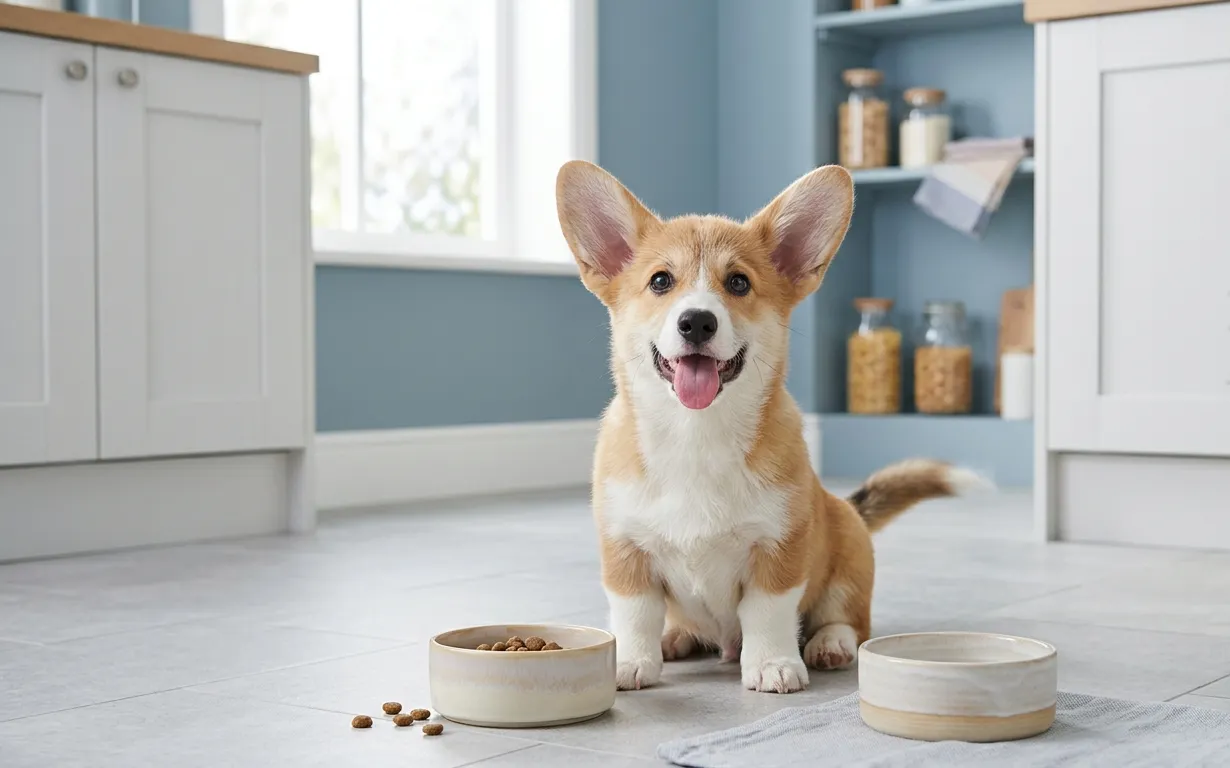
An 8-week-old puppy is about 1 year old in human years. By 3 months they're about 9, by 6 months about 20, and by their first birthday about 31. Puppies age faster than at any other time in their life, then slow down sharply.
These numbers come from a 2020 UC San Diego study that compared DNA aging markers in dogs and people (see about the data). Here's the chart, what each stage looks like, and why the old rules get puppies wrong.
Puppy age in human years: chart
| Puppy age | Human age | Roughly like a |
|---|---|---|
| 8 weeks | ~1 | Baby |
| 10 weeks | ~4–5 | Preschooler |
| 12 weeksabout 3 months | ~7–9 | Young child |
| 16 weeksabout 4 months | ~12 | Pre-teen |
| 5 months | ~17 | Teenager |
| 6 months | ~20 | Late teen |
| 9 months | ~26 | Young adult |
| 1 year | ~31 | Adult |
The early numbers move fast. Between 8 and 12 weeks, every week adds about 1.5 human years, so treat week-level figures as rough. From 6 months on, the pace slows to about 2 human years per month, and to about 1.5 near the first birthday.
Why a puppy is a baby, then a kid, then a teen
The study didn't just produce a formula. The researchers also checked it against life stages that dogs and people go through in the same order:
- Baby (birth to about 2 months). The study matched 8-week-old puppies to babies of about 9 months. Both are growing their first teeth at that age.
- Child (about 2 to 6 months). The stretch after infancy and before puberty, which takes about 1–12 years in people. It overlaps with the window when socializing a puppy matters most.
- Teenager (about 6 months to 2 years). From puberty to the end of growth, like ages 12–25 in people. Many owners notice a "teenage" phase of testing limits around this time.
The match was closest for the baby and child stages. For the teenage years it was rougher: dogs' DNA markers changed faster than the life stage tables alone would suggest.
Why the old rules get puppies wrong
| Rule | 6-month-old puppy | Problem |
|---|---|---|
| Multiply by 7 | 3.5 | A toddler. Many 6-month-olds are already reaching puberty. |
| First year = 15 | 7.5if split evenly | Assumes the first year passes at an even pace. It doesn't: most of it is packed into the first few months. |
| Study formula | ~20 | Fits what owners see: a lanky, testing-the-limits teenager. |
Funnily enough, "multiply by 7" happens to land close at 8 weeks (about 1 year). It drifts further off every month after that.
Does size change a puppy's human age?
A little, but not much in the first year. The study used Labrador Retrievers, so the formula has no separate numbers for small or giant breeds. Size makes a bigger difference later: from age 2, small dogs age more slowly and giant dogs faster (see how old is my dog in human years).
Where size does show up early is growth. Small breeds finish growing and leave the puppy stage sooner, at around 9 months. Giant breeds stay puppies until about 18 months (AAHA, 2019). For when your puppy will be fully grown, see when is a dog considered an adult.
Human age and growth go together
The "preschooler to pre-teen" stretch from 10 to 16 weeks is also when puppies grow fastest. A Labrador puppy gains about 2 lbs a week at that age. Read more in puppy growth spurts, or compare your puppy's weight in the puppy weight chart.
Get your puppy's exact human age
Enter your puppy's age in months in our dog age calculator. It uses the same formula and also shows your puppy's life stage. For puppies under 2 months, it shows the human age in months.
About the data
Human ages come from the formula in Wang et al. (2020): human age = 16 × ln(dog age in years) + 31. The researchers built it by comparing DNA methylation, chemical tags on DNA that change with age, in 104 dogs (mostly Labrador Retrievers) from 0 to 16 years old with the same markers in people. The formula is very steep in the first weeks and drops below zero before about 7.5 weeks, so it isn't meant for newborn puppies. Our calculator scales evenly from zero at birth to the 8-week value for those ages. Life stage ranges come from the same paper.
Sources
- Wang, T., Ma, J., Hogan, A. N., et al. (2020). Quantitative translation of dog-to-human aging by conserved remodeling of the DNA methylome. Cell Systems, 11(2), 176–185. doi.org/10.1016/j.cels.2020.06.006
- Creevy, K. E., Grady, J., Little, S. E., et al. (2019). 2019 AAHA canine life stage guidelines. Journal of the American Animal Hospital Association, 55(6), 267–290. doi.org/10.5326/JAAHA-MS-6999
This article is for informational purposes only and is not a substitute for professional veterinary advice. Always consult a licensed veterinarian for questions about your dog's health.